When you first move to South Korea, one of the small but important adjustments is understanding the time patterns of daily life.
Different businesses and services operate on different schedules — and some rules may surprise foreigners.
From department store closing days to subway schedules, this guide will help you navigate when things are open, closed, or running in Korea.
1. Department Stores
Unlike in some countries where large department stores are open 7 days a week, most department stores in Korea close once a week.
- Typical Closing Day: Monday or Tuesday, depending on the chain.
- Examples:
- Lotte Department Store: Often closed on Monday.
- Shinsegae Department Store: Often closed on Tuesday.
- Why? Traditionally, this allows staff rest and store maintenance.
- Opening Hours: Usually 10:30 AM – 8:00 PM, extended to 9:00 PM on weekends or special sale events.
Tip for Foreigners: Always check the specific branch’s schedule before visiting — the closing day can differ between locations.
2. Large Supermarkets (Hypermarkets)
Chains like E-Mart, Homeplus, and Lotte Mart are legally required to close twice a month, usually on Sundays.
- Typical Schedule in Seoul: Closed on the second and fourth Sunday of the month.
- Opening Hours: Around 10:00 AM – 11:00 PM.
- Reason: Government policy to protect small neighborhood stores.
Tip: On closure days, smaller local supermarkets (슈퍼마켓) and convenience stores remain open.
3. Convenience Stores
Convenience stores (편의점) such as GS25, CU, and 7-Eleven are often 24 hours, but not always.
- Exceptions: Some locations in residential areas may close between midnight and 6:00 AM due to low demand or local regulations.
- Popular Feature: Even at night, you can buy food, drinks, and basic necessities.
4. Cafés and Study Cafés
- Starbucks: Usually 7:00 AM – 10:00 PM (some branches close earlier or later depending on location).
- Independent Cafés: Often 10:00 AM – 8:00 PM.
- Study Cafés (스터디카페): Many are 24 hours, especially unmanned ones. You enter with a key code or mobile app access.
5. Public Transport
Subway
- Weekday Schedule: Usually first train ~5:30 AM, last train around midnight.
- Weekend/Holiday Schedule: Slightly reduced frequency, last train still around midnight.
- Tip: The exact last train time depends on the line and direction — check apps like KakaoMetro.
Buses
- Operating Hours: First bus ~4:30–5:00 AM, last bus ~11:30 PM–midnight.
- Difference on Weekends: Same start/end times, but longer intervals between buses.
6. 24-Hour Spaces
Even though not everything in Korea is 24 hours, some spaces are:
- Study Cafés & PC Bang (internet cafés): Almost always 24/7.
- Some Gyms: Unmanned fitness centers operate 24 hours.
- Certain Restaurants: BBQ spots, noodle shops, and fast-food chains in busy districts.
7. Why Understanding These Patterns Matters
Foreigners often plan activities assuming “everything is open every day” — but in Korea:
- You might arrive at a closed department store on a Monday.
- The large supermarket might be shut on a Sunday.
- The last subway train might leave earlier than expected.
By knowing the time structure of Korean daily life, you can plan better and avoid surprises.
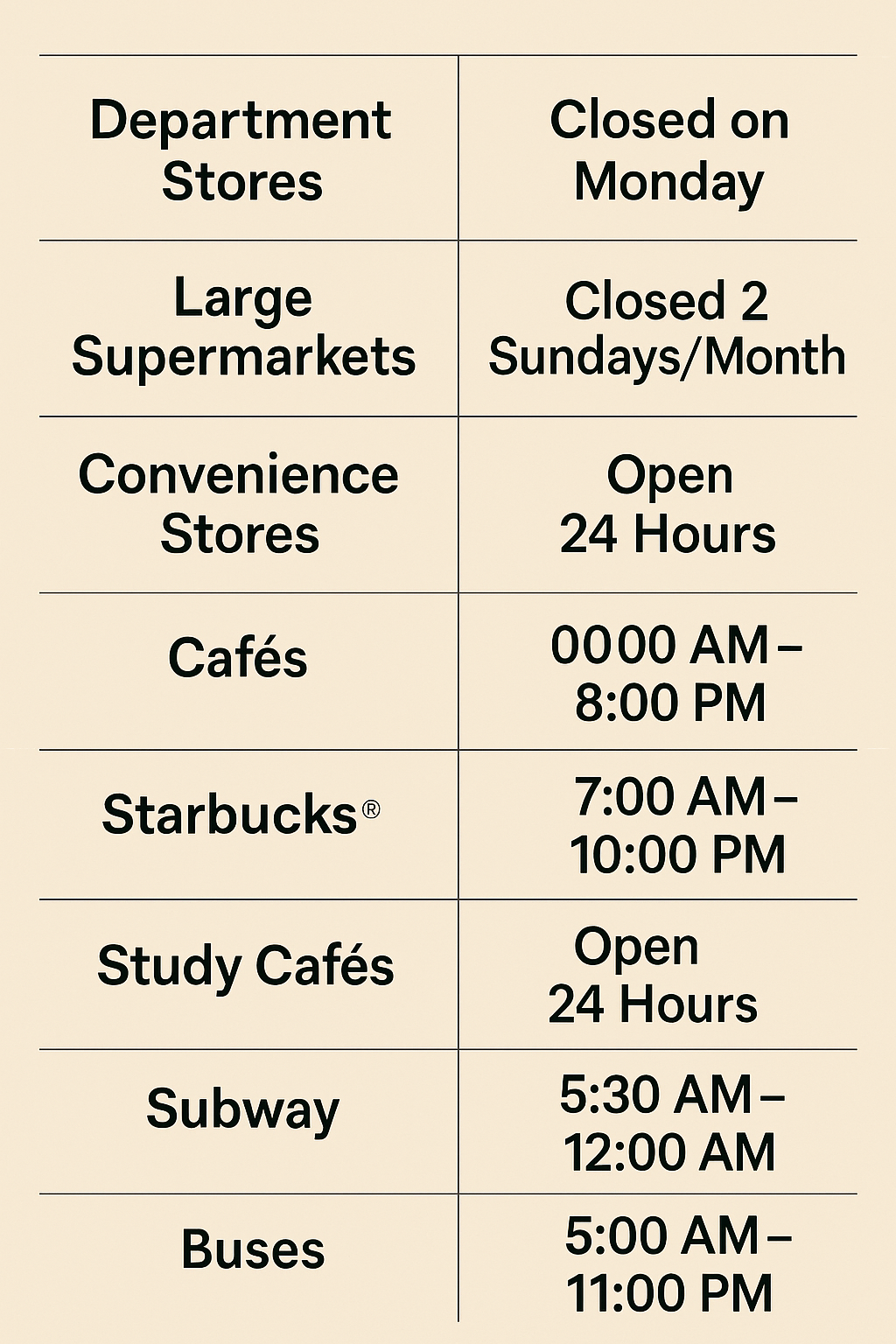
8. Quick Reference Table
| Department Store | 10:30 AM – 8:00 PM | Mon or Tue (varies) |
| Large Supermarket | 10:00 AM – 11:00 PM | 2 Sundays/month |
| Convenience Store | 24h or 7:00 AM – 12 AM | Rare closures overnight |
| Starbucks | 7:00 AM – 10:00 PM | None (hours vary) |
| Independent Café | 10:00 AM – 8:00 PM | Varies |
| Subway | ~5:30 AM – ~12:00 AM | None |
| Bus | ~4:30 AM – ~12:00 AM | None |
| Study Café | 24h | None |
Final Thoughts
Life in South Korea runs on a well-structured but varied timetable. Once you understand these patterns — when department stores close, when buses slow down, which cafés are 24 hours — you’ll navigate the city with confidence and make the most of your time here.
Online Shopping in South Korea for Foreigners: Platforms, Payment Methods, Address Tips, and Delivery System
As summer slowly fades into autumn in South Korea, you may find yourself looking for new clothes, seasonal home items, or even gifts for friends and family. And just like in most countries, online shopping here is a big part of daily life. For foreigners l
fragment-seoul.tistory.com
How Subway Exit Numbers Work in South Korea: A Simple Guide for Foreigners
If you’ve used the subway in South Korea, you’ve probably noticed something: there are a lot of exits. In major stations like Gangnam or Hongdae, there can be over a dozen — sometimes more than twenty. For foreigners, this can feel overwhelming at fi
fragment-seoul.tistory.com
Public Wi-Fi in South Korea: How It Works, Where to Use It, and Why It’s So Fast
When foreigners visit South Korea, they often notice something remarkable — you’re almost never without internet access. Whether you’re riding the subway, sitting in a café, waiting at the airport, or even on a public bus, chances are there’s free
fragment-seoul.tistory.com
Everyday Convenience in South Korea: Small Details That Make Life Surprisingly Easier
When people talk about South Korea, the first things that usually come to mind are K-pop, high-tech gadgets, and ancient palaces. But if you spend more than a week here, you’ll notice something far more fascinating: it’s not just the big, flashy techno
fragment-seoul.tistory.com
Essential Documents and Photo Sizes for Foreigners Living in South Korea
If you’re planning to live in South Korea for work, study, or long-term residence, you’ll quickly learn that different documents require different photo sizes. Whether it’s for your Alien Registration Card, driver’s license, or visa renewal, having
fragment-seoul.tistory.com
🏦 How to Open a Bank Account in Korea as a Foreigner (2025 Expat Guide)
✨ IntroductionIf you’re planning to live, work, or study in Korea, one of the first things you’ll need is a Korean bank account. ✅ Receive your salary✅ Pay rent & bills✅ Use mobile payments like KakaoPay & NaverPay✅ Easily send/receive money
fragment-seoul.tistory.com
💕 Why Koreans Call Their Partner “Oppa” and Their Kids “Princess” – Understanding Korean Terms of Endearment
✨ IntroductionIn English, you might call your loved one honey, baby, darling, or pumpkin. But in Korea, you’ll hear completely different words: ✅ Couples call each other yeobo (여보), jagiya (자기야), or even oppa (오빠).✅ Parents call their
fragment-seoul.tistory.com
💼 Working in Korea 2025: Foreign Workers’ Rights, Labor Law, Overtime Pay & Visa Rules Explained
✨ IntroductionThinking about working in South Korea in 2025? Whether you’re an English teacher, a factory worker, a researcher, or a professional in IT, knowing Korean labor law and your rights as a foreign worker is essential. But many foreigners ask:
fragment-seoul.tistory.com
🏙 Exploring Korea’s Trendy ‘-ridan-gil’ Streets: Best Spots for Food, Fashion & Weekend Vibes
✨ IntroductionIf you’re visiting Korea and asking locals where to hang out on the weekend, you might hear strange names like Gyeongridan-gil (경리단길), Songridan-gil (송리단길), or Haebangchon near Gyeongridan. So what’s this “-ridan-gil
fragment-seoul.tistory.com


